
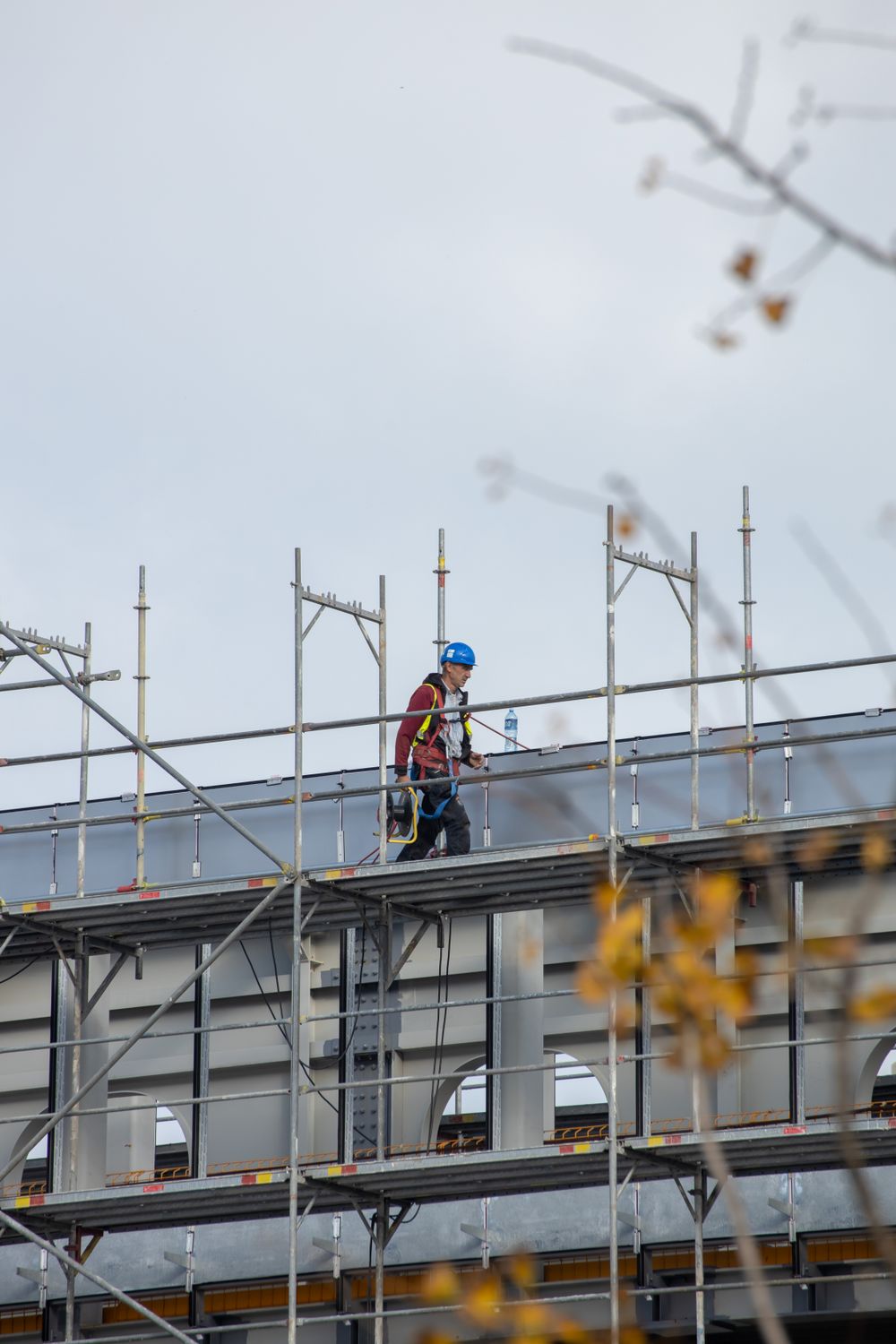
Working at Heights: A Practical Guide for Irish Workplaces
Falls from height remain one of the most common causes of serious workplace injury in Ireland. This guide explains what work at height actually means, how to plan it sensibly and the order in which controls should be applied — in plain language, with Irish law in mind.
Whether you are clearing a gutter, changing a light fitting in a warehouse or erecting structural steel, the principle is the same: a fall of even a short distance can cause a life-changing injury. In Ireland, the way work at height is managed is governed by the Safety, Health and Welfare at Work Act 2005 and, more specifically, by Part 4 of the Safety, Health and Welfare at Work (General Application) Regulations 2007, which deals directly with work at height. The Health and Safety Authority (HSA) is the body responsible for enforcement.
What counts as “work at height”?
A common misconception is that work at height only applies above a certain number of metres. It does not. Under Irish law, work at height means working in any place where, if precautions were not taken, a person could fall a distance liable to cause personal injury. That includes working at, above or below ground level, and it covers access to and exit from such a place.
In practice, this means a worker on a low platform, beside an unprotected edge, or near an opening in a floor is all working at height. The duty to assess the task does not begin at two metres — it begins the moment a fall could cause harm.
The duty to plan before you climb
The single most important step happens before anyone leaves the ground. Every task at height should be properly planned, supervised and carried out by people who are competent to do it. Planning means asking honest questions: Does this work need to happen at height at all? What equipment is right for the duration and nature of the job? What is the rescue plan if something goes wrong?
The safest height-related task is the one that never has to be done at height. If you can bring the work to the ground, you have removed the risk entirely.
This mindset sits at the heart of the legal approach in Ireland: the law expects employers to avoid work at height where it is reasonably practicable to do so, and only then to manage the risk of those tasks that genuinely must be performed up high.
The hierarchy of control
When work at height cannot be avoided, controls should be applied in a clear order of preference. Each step down the list is generally less protective than the one above it.
- Avoid the work entirely — for example, by assembling at ground level or using long-handled tools.
- Prevent falls using collective protection — guard rails, working platforms, scaffolds and mobile elevating work platforms (MEWPs) protect everyone in the area without relying on individual behaviour.
- Prevent falls using personal protection — a work-restraint system that physically stops a worker reaching the edge.
- Minimise the distance and consequences of a fall — fall-arrest harnesses, soft-landing systems or nets, used only when higher measures are not reasonably practicable.
Collective measures that protect a whole work area are always preferred over personal measures that protect only one person. A guard rail does not need to be remembered, fitted correctly or maintained by the worker on the day — it is simply there.
Working at Heights training from €33
Self-paced, HSA-aligned, certificate the same day — €33 per person.
Choosing the right access equipment
The equipment you select should match the task, not the other way around. A ladder may be perfectly suitable for a short, light, low-risk job, but it is rarely the right choice for sustained work or for tasks that require both hands and a stable base. Scaffolds, podium steps, tower scaffolds and MEWPs each have their place. The decision should follow from the risk assessment, the duration of the work, the load involved and the working environment.
Whatever is chosen must be inspected before use, maintained in good condition and used only by people who understand its limits. Worn footwear on a wet platform, an overloaded ladder or a tower that has not been tied off are everyday failures that turn a routine job into an emergency.
Competence and training
Irish law places competence at the centre of safe work at height. A worker is competent when they have the knowledge, training and experience to carry out the task safely and to recognise when something is wrong. Awareness training helps everyone on site understand the hierarchy of control, how to inspect equipment, how to spot fragile surfaces and what to do if a colleague falls.
For supervisors and managers, training also supports the planning duty: knowing how to select equipment, how to write a practical method statement and how to build a workable rescue plan rather than a paper one.
✅ Key takeaways
- Work at height is any task where a fall could cause injury — there is no minimum height threshold.
- It is governed in Ireland by the 2005 Act and Part 4 of the General Application Regulations 2007, enforced by the HSA.
- Always avoid the work at height first; only manage the risk of tasks that genuinely cannot be avoided.
- Apply controls in order — collective protection before personal protection, prevention before arrest.
- Plan the job, inspect the equipment, and make sure everyone involved is genuinely competent.
Putting it into practice
Good height safety is rarely about expensive equipment. It is about taking a few minutes to plan, choosing the right tool for the job, and making sure the people doing the work understand the risk. A short, structured course gives teams a shared language for that conversation — so that planning, equipment checks and rescue arrangements become routine rather than afterthoughts. If you want to go deeper on the legal duties, our overview of the work at height regulations in Ireland breaks them down section by section, and our guide to preventing falls from height looks at the practical measures in more detail.


