
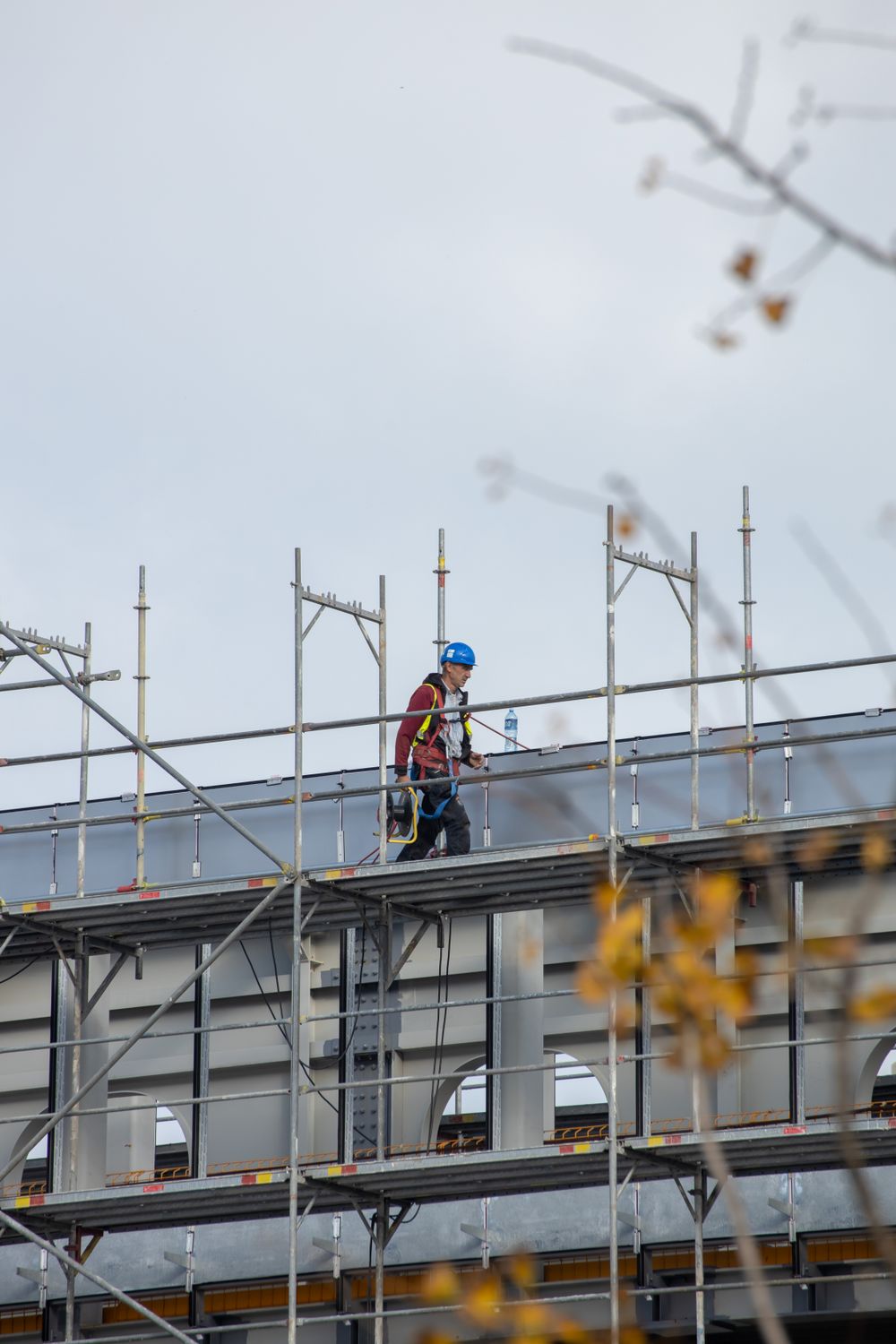
Work at Height Regulations in Ireland: What the Law Requires
If you employ people who work above, below or near an edge, the law expects a structured approach. This article sets out the Irish legal framework for work at height — what it covers, who is responsible, and what the duties actually mean in day-to-day terms.
Irish workplace safety law is built on a simple foundation: those who create a risk are responsible for controlling it. For work at height, two pieces of legislation matter most. The Safety, Health and Welfare at Work Act 2005sets out the broad duties of employers, the self-employed and employees. Part 4 of the Safety, Health and Welfare at Work (General Application) Regulations 2007 then deals specifically with work at height, spelling out how those general duties apply when a fall is possible. The Health and Safety Authority (HSA) is the State body that provides guidance and enforces compliance.
The scope of the regulations
The regulations define work at height broadly. It is any work in a place from which a person could fall a distance liable to cause personal injury, including access to and from that place. Crucially, there is no minimum height at which the duties begin. A fall from a low platform onto a hard surface, or through a fragile roof light, can be just as serious as a fall from a scaffold.
This wide definition is deliberate. It forces a focus on the consequences of a fall rather than an arbitrary measurement, which is why a one-metre task next to an unguarded opening can demand as much planning as work several storeys up.
Employer duties
Under the 2005 Act and Part 4, an employer must ensure, so far as is reasonably practicable, that work at height is properly planned, appropriately supervised and carried out safely. The duties break down into a recognisable pattern:
- Avoid the risk — do not carry out work at height where it is reasonably practicable to do the work safely otherwise.
- Assess and plan — carry out a risk assessment, select suitable equipment, and take account of weather, the condition of surfaces and the people involved.
- Use the right work equipment — choose collective protection (such as guard rails) over personal protection, and prevention over fall arrest.
- Inspect and maintain — ensure equipment is inspected, in good condition and fit for purpose.
- Provide information, instruction and training — make sure everyone involved is competent for their role.
The law does not demand the impossible. It asks for what is reasonably practicable — a balance between the level of risk and the effort, time and cost of controlling it. Where the risk is serious, far more is expected.
Duties of employees
Responsibility is shared. The 2005 Act places clear duties on employees too: to take reasonable care of their own safety and that of others, to use equipment correctly, to follow the training and instruction they have received, and to report any defect or dangerous situation they become aware of. A worker who removes a guard rail for convenience, or who uses damaged equipment, may be in breach of their own legal duties.
Working at Heights training from €33
Self-paced, HSA-aligned, certificate the same day — €33 per person.
Fragile surfaces and falling objects
Part 4 gives particular attention to two hazards that cause many of the most serious incidents. The first is fragile surfaces — roof lights, asbestos cement sheets and worn coverings that can give way underfoot. The regulations require that these be identified and that suitable platforms, coverings or guard rails be used so that no one relies on a fragile surface to bear their weight. The second is falling objects: tools, materials and debris must be prevented from falling, and exclusion zones or toe boards used where a risk to people below remains.
How the HSA enforces the law
HSA inspectors have the power to visit workplaces, examine work at height arrangements and take action where they find shortcomings. Their tools range from verbal advice and written reports to improvement notices and prohibition notices, the latter of which can stop dangerous work immediately. The most effective way to stay on the right side of the law is not to react to an inspection but to build sound practice in from the start — a documented risk assessment, suitable equipment, inspection records and a competent, trained workforce.
✅ Key takeaways
- Work at height in Ireland is governed by the 2005 Act and Part 4 of the General Application Regulations 2007.
- There is no minimum height — the duties apply wherever a fall could cause injury.
- Employers must avoid, assess, plan, equip, inspect and train; employees must use equipment properly and report defects.
- Fragile surfaces and falling objects receive specific attention in the regulations.
- The HSA enforces compliance and can issue improvement or prohibition notices.
Turning the law into routine
Regulations only protect people when they shape everyday behaviour. The practical translation of these duties is consistent: plan the job, pick the safest equipment, check it, and make sure the people using it know what they are doing. Our broader working at heights guide shows how the hierarchy of control fits together, while our piece on preventing falls from height focuses on the controls themselves. A certified awareness course is a straightforward way to demonstrate that your workforce is competent under the law.


