
CPR and Defibrillator Basics Everyone Should Know
When a heart stops, the clock becomes the enemy. Confident bystander CPR and early use of a defibrillator can be the difference between a full recovery and a tragedy — and neither is as daunting as people imagine.
Sudden cardiac arrest does not announce itself. A colleague who seemed fine collapses, stops breathing normally and is unresponsive. In that moment, the people standing nearby — not the ambulance crew still minutes away — hold the casualty's best chance. That is why basic cardiopulmonary resuscitation (CPR) and the use of an automated external defibrillator (AED) belong in every workplace, not just a hospital.
The chain of survival
Resuscitation specialists describe the response to cardiac arrest as a chain. Each link is weak on its own but powerful in sequence:
- Early recognition and call for help — spot the collapse and ring 112 or 999 immediately.
- Early CPR — start chest compressions to keep blood moving to the brain and heart.
- Early defibrillation — apply an AED, which can restart a heart in a shockable rhythm.
- Post-resuscitation care — handover to paramedics and the hospital.
The first three links happen before professional help arrives, which is exactly why bystander confidence matters so much.
Doing imperfect CPR is enormously better than doing nothing. The only truly wrong response to a cardiac arrest is to stand back and wait.
CPR in simple terms
You do not need to memorise a textbook to act well. The core sequence is short:
- Check the scene and the casualty. Make sure it is safe, then check for a response and normal breathing. Occasional gasping is not normal breathing.
- Call for help. Phone the emergency services and ask someone to fetch the nearest AED.
- Push hard and fast. Place your hands in the centre of the chest and compress firmly at a steady rhythm, allowing the chest to recoil fully between compressions.
- Keep going. Continue until the AED is ready, the casualty shows signs of life, or professional help takes over. Swap with another rescuer every couple of minutes if you can, because good compressions are tiring.
Training adds rescue breaths and refinements, but high-quality, uninterrupted compressions are the foundation everything else rests on.
Using an AED
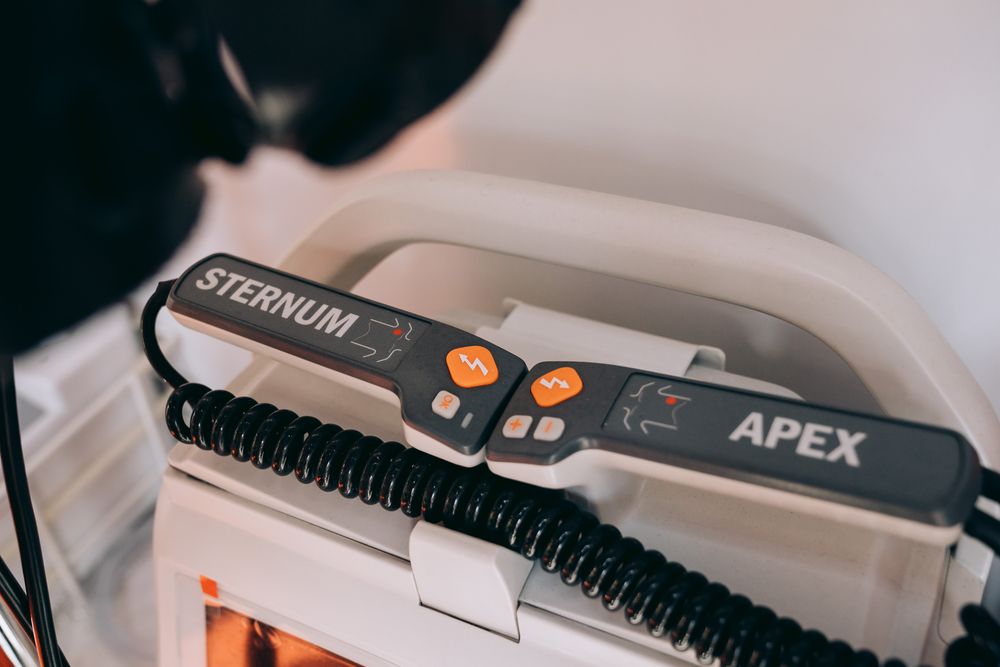
The single biggest myth about defibrillators is that they are complicated or dangerous to use. They are designed precisely for untrained members of the public. Once switched on, an AED talks you through every step with clear voice prompts.
What the AED does for you
- It tells you where to place the pads, usually shown by pictures on the pads themselves.
- It analyses the heart rhythm automatically and decides whether a shock is needed.
- It will only deliver a shock if the rhythm is shockable — you cannot accidentally shock a beating heart.
- It prompts you to resume compressions immediately after any shock.
Your only jobs are to keep everyone clear during analysis and shock, and to keep doing CPR whenever the device tells you to.
✅ Key takeaways
- Cardiac arrest survival depends on bystanders acting in the first minutes, not on waiting for an ambulance.
- The chain of survival is recognise, call, CPR, defibrillate, then handover.
- High-quality chest compressions — hard, fast and uninterrupted — are the heart of CPR.
- An AED guides you with voice prompts and only shocks a heart rhythm that needs it.
- Imperfect action beats no action every single time.
Where this fits in Irish workplaces
Under the Safety, Health and Welfare at Work Act 2005 and Part 7 of the General Application Regulations 2007employers must make risk-based first aid provision overseen by the Health and Safety Authority (HSA). For many organisations, that includes trained first aiders who are competent in CPR and, increasingly, an on-site AED that staff know how to find and use. If your workplace has a defibrillator, make sure people know where it is, that its pads and battery are in date, and that it appears in your emergency plan.
First Aid training from €33
Self-paced, HSA-aligned, certificate the same day — €33 per person.
Confidence comes from practice
Reading about CPR is a good start, but muscle memory is what carries you through the real thing. Hands-on training removes hesitation, and refreshing your skills keeps them sharp. To understand the wider employer duties, read our guide to first aid at work in Ireland, and if you are sizing up your team's cover, see how many first aiders your workplace needs.


